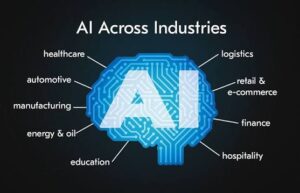
Artificial intelligence is becoming an important part of modern business transformation. Organizations across different sectors are adopting advanced technologies to improve productivity, automate repetitive activities, reduce operational costs, and deliver better customer experiences. From manufacturing and healthcare to retail, banking, and education, AI is helping businesses solve complex challenges and make smarter decisions. AI for Industries represents the growing use of intelligent technologies to improve business processes and create new opportunities for innovation. By combining machine learning, automation, data analytics, and intelligent software, companies can develop more efficient systems and remain competitive in an increasingly digital marketplace.
Transforming Manufacturing with Intelligent Automation
The manufacturing industry is experiencing significant changes through artificial intelligence and automation. Traditional production processes often require continuous monitoring, manual inspections, and regular equipment maintenance. AI-powered systems can analyze production data, identify unusual patterns, and help manufacturers improve operational performance.
Predictive maintenance is one of the most valuable applications of AI in manufacturing. Intelligent systems can examine equipment performance and identify potential problems before major failures occur. Computer vision technology can also inspect products and detect quality issues during production. These capabilities help manufacturers reduce downtime, improve product quality, and use resources more effectively.
Improving Healthcare Services with Artificial Intelligence
Healthcare organizations are increasingly exploring artificial intelligence to improve patient services and support medical professionals. AI-powered applications can analyze medical images, organize patient information, assist with appointment scheduling, and support administrative workflows.
Machine learning systems can help healthcare professionals identify patterns in medical data, while conversational assistants can provide general information about available services and treatment procedures. AI tools can also help hospitals manage resources and improve scheduling efficiency. However, medical decisions must remain under appropriate professional supervision, with patient privacy and data security treated as essential priorities.
Revolutionizing Retail and E-Commerce Businesses
The retail industry is using AI to create more personalized and convenient shopping experiences. Customers expect relevant product recommendations, quick assistance, and simple purchasing processes. Artificial intelligence helps businesses understand shopping preferences, analyze customer behavior, and improve product discovery.
AI-powered recommendation engines can suggest products based on browsing activity and previous purchases. Chatbots can answer questions about product features, shipping information, and return policies. Retailers can also use predictive analytics to estimate product demand and improve inventory management. Ai for Industries is helping retail organizations develop smarter business strategies while improving customer engagement and operational efficiency.
Enhancing Banking and Financial Services
Artificial intelligence is transforming the financial sector by improving data analysis, customer support, and risk management. Banks and financial institutions handle large volumes of transactions and customer information, making automation particularly valuable.
AI-powered systems can identify unusual transaction patterns, support fraud detection, and help financial organizations evaluate potential risks. Intelligent virtual assistants can answer common banking questions and guide customers through basic service processes. Automated data analysis also helps financial teams organize information and make more informed business decisions. Strong security measures and regulatory compliance remain essential when implementing these technologies.
Modernizing Education Through AI-Powered Solutions
The education sector is adopting artificial intelligence to make learning more accessible and efficient. AI-based learning platforms can analyze student performance and recommend educational resources according to individual learning requirements.
Intelligent tutoring assistants can explain concepts, answer general academic questions, and help students practice different subjects. Educational institutions can also automate administrative activities such as admission inquiries, course information requests, and scheduling. Teachers can use AI-powered tools to organize educational materials and identify areas where students may need additional support. These applications help create more flexible learning environments while allowing educators to focus on teaching and student development.
AI Applications in Logistics and Transportation
Logistics and transportation companies are using artificial intelligence to improve delivery operations, route planning, and supply chain management. Managing transportation schedules and inventory can become complicated when businesses operate across multiple locations.
AI-powered analytics can examine traffic conditions, delivery information, and demand patterns to support better planning. Intelligent systems can also help warehouses organize inventory and improve order processing. Predictive tools allow businesses to anticipate possible supply chain disruptions and prepare suitable responses. These capabilities help organizations improve efficiency and provide more reliable services.
Future Opportunities for AI Across Different Industries
The future of artificial intelligence will bring new opportunities for businesses across almost every sector. Advancements in generative AI, robotics, machine learning, and intelligent automation will make digital systems more capable of handling complex activities.
Organizations will increasingly adopt AI-powered assistants, predictive analytics, automated workflows, and intelligent decision-support tools. AI for Industries will continue to evolve as businesses discover new ways to use technology for innovation, customer engagement, and operational improvement. Companies that invest in suitable AI solutions while maintaining responsible data practices will be better prepared for future market changes.
Conclusion
Artificial intelligence is changing how modern industries operate by improving efficiency, supporting better decisions, and creating more personalized customer experiences. From manufacturing and healthcare to retail, banking, education, and transportation, AI offers valuable opportunities for organizations of different sizes. Successful implementation requires suitable technology, reliable data, strong security practices, and continuous performance monitoring. Investing in AI for Industries can help businesses streamline operations, improve productivity, and build innovative solutions that support sustainable growth in the digital era.
